Moose And Elk!

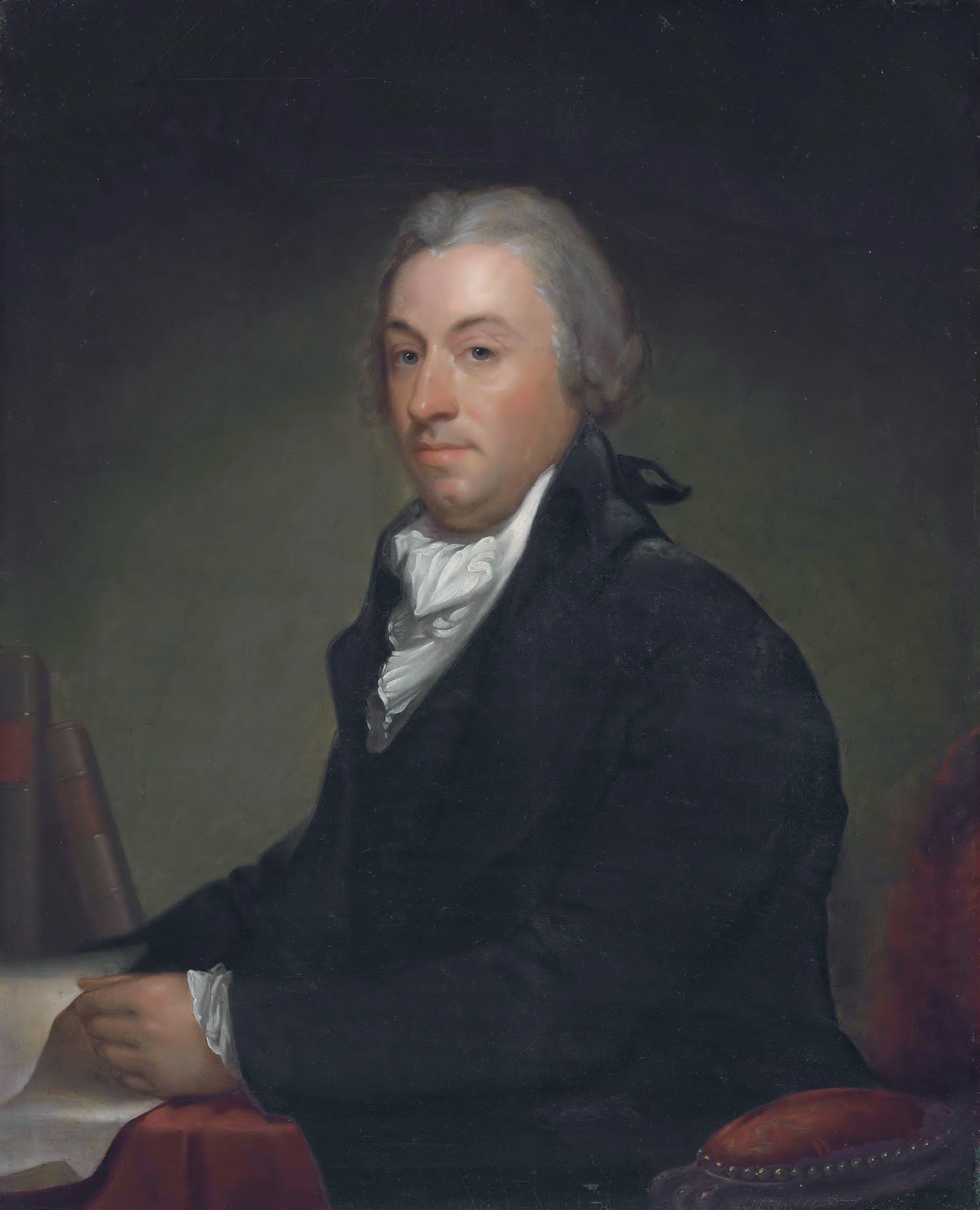
In addition to his work in government and international relations Chancellor Robert R. Livingston also worked on improving he agricultural society of America. As a founding member and president of the Society for the Promotion of Agriculture, Arts and Manufactures, along with Stephen Van Rensselaer, Simeon DeWitt, Gouveneur Morris and many others, the Chancellor filled the pages of the Transactions of the Society with his thoughts, ideas and transactions

In one experiment, that Boris and Natasha
could have probably gotten behind, he tried to domesticate elk and moose. This was published in the Transaction of the Society for the Promotion of Agriculture, Arts and Manufactures Instituted in the State of New-York, Volume I in 1801. This was based on an observation of his that every society, every place that people developed seemed to be provided with animals that could serve as beasts of burden. Cattle and horses in Europe, elephants in parts of Asia, the camel in North Africa, even the llama in South America and reindeer in the far north. In fact it was only the zebra and giraffe that he couldn\’t understand as to how they escaped being domesticated. He saw moose and elk as the equivalent animals in North America.

Definitely no problems putting a harness on an animal with antlers like that 

For some reason the Chancellor had more ready access to elk. In fact he owned three that he kept pastured with his cattle. He took two of these elk, each about two years old, and twice tried putting them in a harness. He was very encouraged by his results. Both animals took a bit about as easily as a colt of similar age. One problem he quickly saw though is that the animals had delicate mouths that could be easily damaged if the bit was mishandled.

So graceful and majestic

Based on these experiments the Chancellor felt that Elk could best be used pulling carriages. They were as muscular as horses but their natural gate is a faster so they could, in theory, out pull a horse.

The Chancellor never had the chance to experiment in real life on a moose. He apparently only ever examined a dead juvenile. The rest of his knowledge was based on books and stories told by hunters. He saw the great musculature of moose as an advantage and believed that they could grow up to ten feet tall in domesticity because they wouldn\’t be desperate for food in the winter.
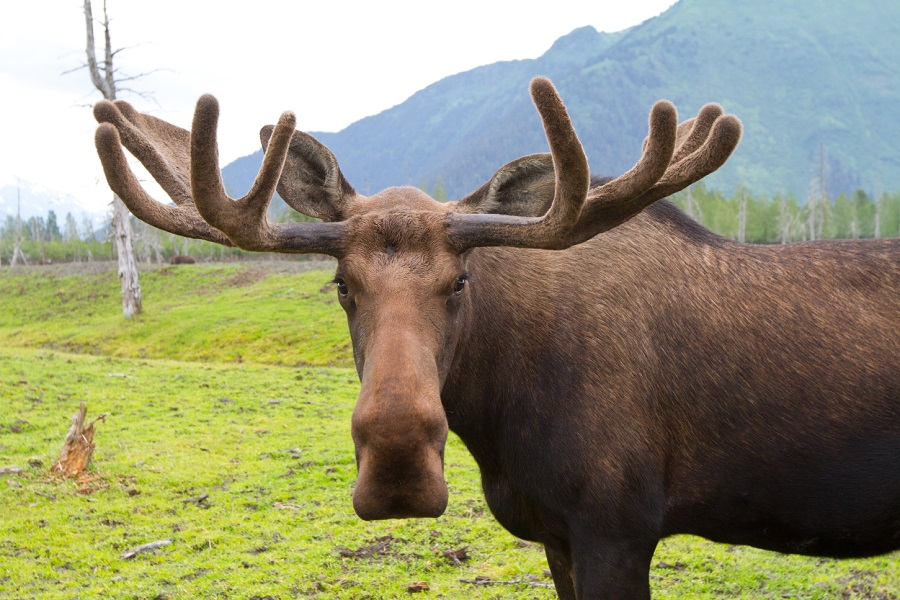
You ain\’t a pageant winner either 

The only draw back to moose in the Chancellor\’s eyes was that they were ugly. In his words; \”we must however , except beauty, for few animals have a more uncouth appearence; the head is out of all proportion large, the neck shorter than the head, the body much shorter compared to its height than that of either horse or ox.\”

He was most offended by the hind end of the moose, \”the tail, if it may be so called, is a broad, short flap, that hardly covers the anus.\”
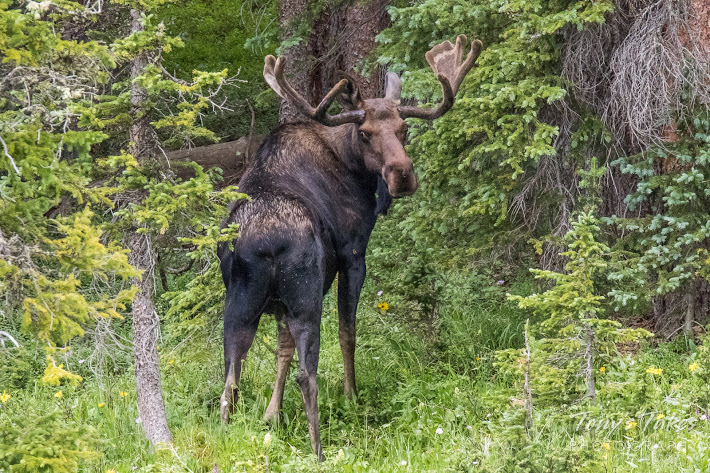
He wasn\’t wrong


That reason was the Louisiana Purchase

 For some reason, despite his early success with these experiments the Chancellor never continued on with them and they were never picked up by anyone else on any large scale. His experiments with elk continued to make its way into print for nearly a hundred years. Its mentioned in 1803\’s Animal Biography; or Anecdotes or the Lives, Manners and Economy, of the Animal Creation Arranged According to the System of Linnaeus by W. Bingley, 1832\’s A Book of Quadrupeds for Youth and in a 1901 article in the Albany Argus by Judge Robert Earl, who was pushing to start attempting to domesticate both animals again. It was even written about in a blog in 2019. See here Even still no one has jumped into this effort whole heatedly.
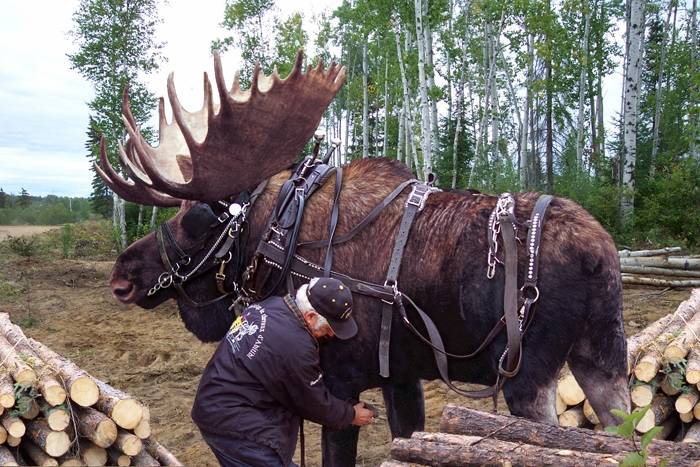
Except this guy. He\’s some kind of moose whisperer 

The Alien and Sedition Acts

Edward Livingston and the Alien and Sedition Acts

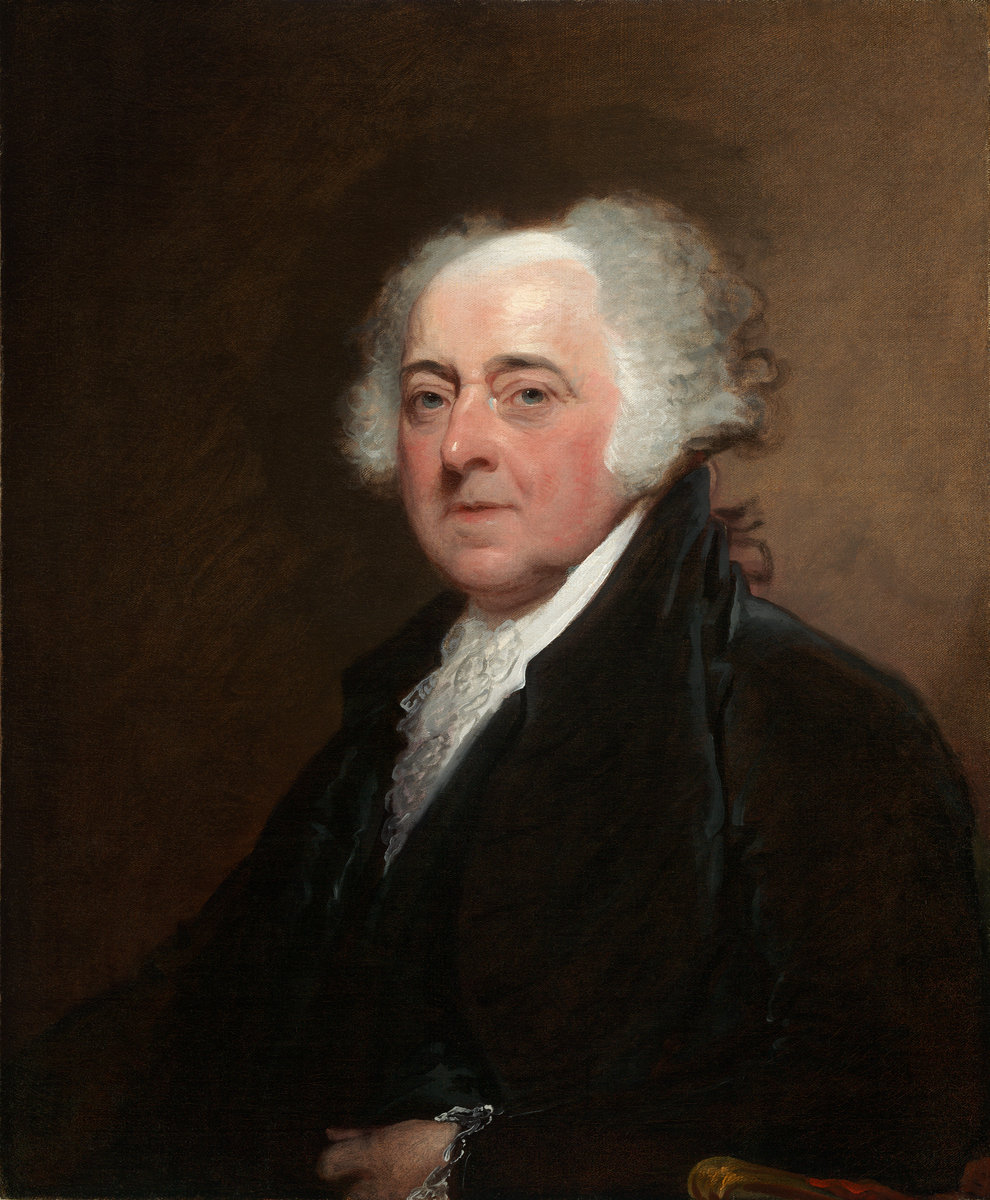
John Adams’ term as President is not a high point of American history. In fact, with the Alien and Sedition Acts, he and the Federalists managed to pass some of the most un-American legislation in history. Forget four score and seven years, the Federalists could not wait twenty years before they tried to create a dictatorship.
          The Alien and Sedition Acts essentially allowed John Adams to imprison or fine any one he wanted. Specifically, the Sedition Act allowed the President to imprison or fine anyone who criticized the government. The Alien Acts allowed for the imprisonment or fining of anyone born in another country. The Naturalization Act, which is also lumped in with this other nonsense, raised the years of residency from five to fourteen in order to become a citizen of the country.
          The Federalists claimed that new immigrants were harming the country. European radicals were coming to America to start the next French Revolution! Harrison Gray Otis, a Massachusetts Federalist congressman, exclaimed that there was no need to “invite hordes of Wild Irishmen, not the turbulent and disorderly of all the world to come here with a basic view to distract our tranquility.”[i] The truth of course was that new immigrants had proven more likely to vote for the Democratic-Republican party and the Federalists had to do something about the erosion of their power.
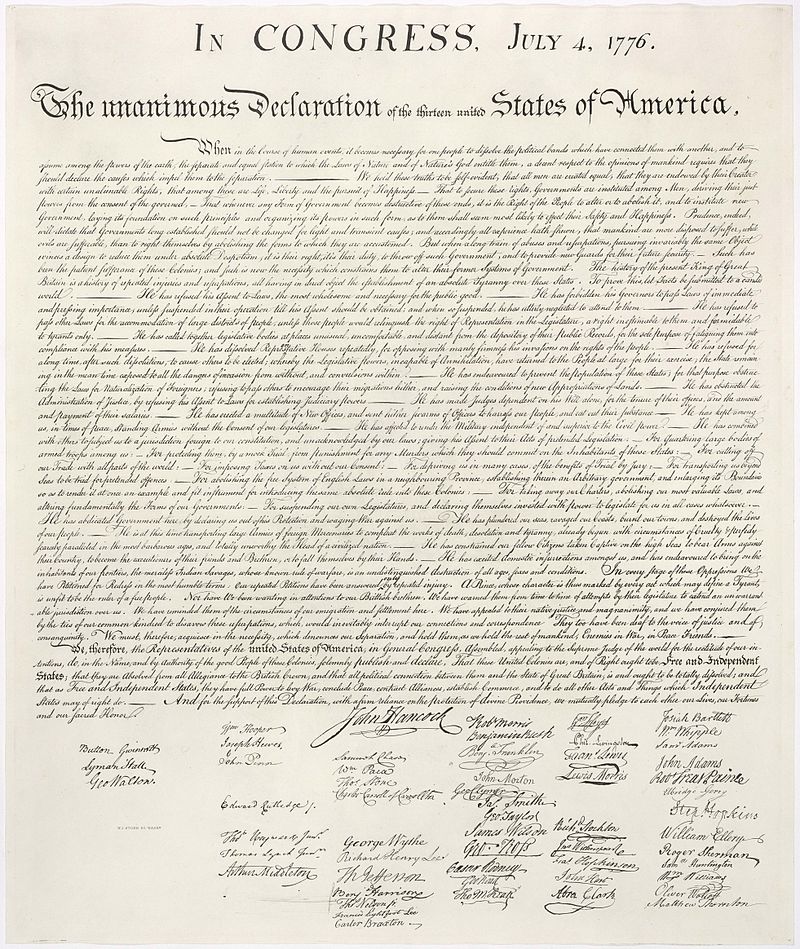
          So why was this attempt to discourage immigration so un-American? Let’s take a look at the Declaration of Independence. You know the document that John Adams supposedly helped to write? Although the fact that he signed these Acts into law makes one wonder if he ever even read it. After you get past the Life, Liberty and Pursuit of Happiness part, the Declaration becomes a list of complaints against King George III. One of them reads as follows:
“He has endeavoured to prevent the population of these States; for that purpose obstructing the Laws for Naturalization of Foreigners; refusing to pass others to encourage their migrations hither, and raising the conditions of new Appropriations of Lands.”
To put it simply, the idea the immigrants are welcome here, necessary here, is one of the founding principles of the United States of America. Unanimous, indisputable, right there on the parchment.
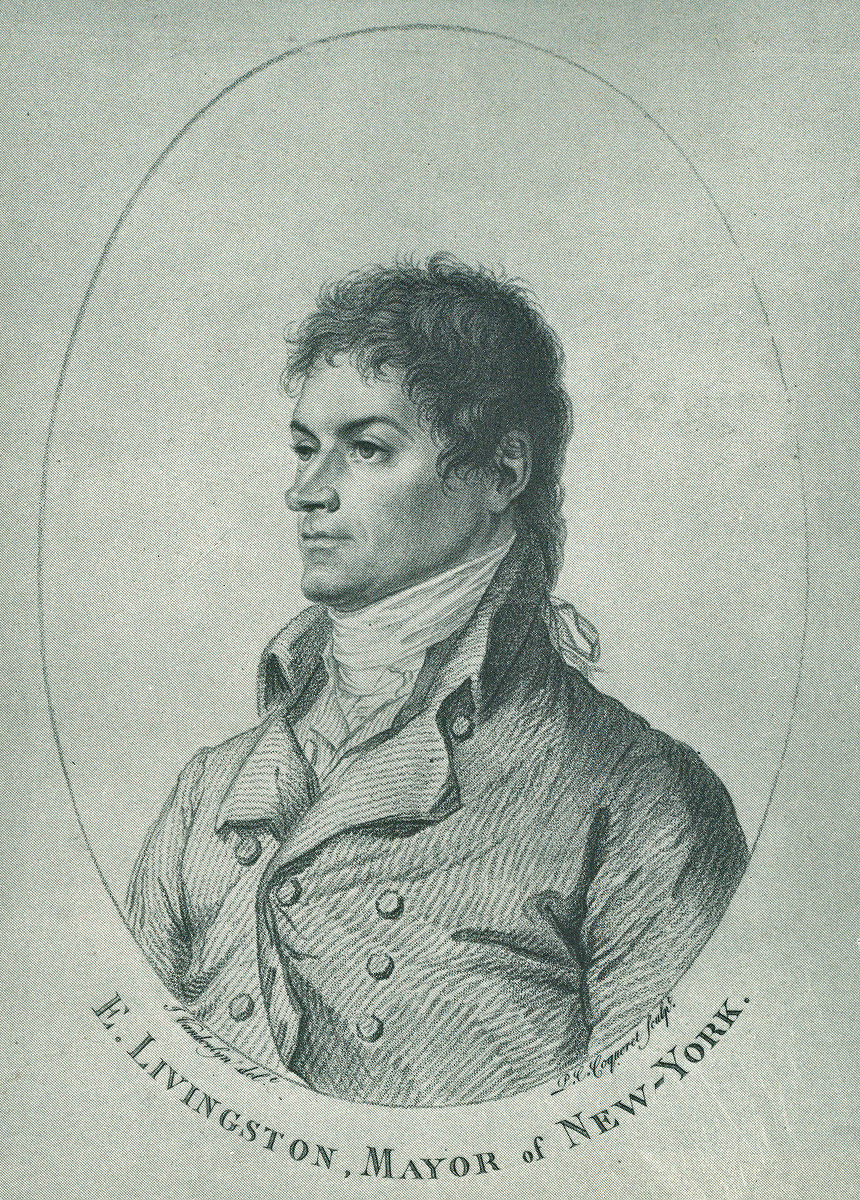
When the Alien Friends Act was read before Congress in May of1798, Edward Livingston gave it a stinging, three-hour long rebuke on the floor. Newspaper accounts of his speech would take up ten full columns. This earned him the scorn of Abigail Adams who wrote; “we want more Men of Deeds, and fewer of Words.”[ii]Of course the Adams had hated the Livingstons for more than two decades at this point and Abigail was always quick to defend her husband.
         

And he did need defending. In the speech Edward Livingston called out the Federalist party for trying to “complete the picture of tyranny” by giving John Adams the power to dispose of his enemies with no oversight. Several journalists were imprisoned or fined under the Sedition Act for criticizing Adams’ administration. The Alien Act would allow him to do the same to others based solely on their place of birth and the President’s “present interest or passion”

          Having shown over the course of his three-hour lecture that the bill was “at war with the fundamental principles of our government” Livingston and the other Democratic-Republicans could only hope they had swayed enough of the majority Federalists that the bill would not move forward. They had not and the bill moved on and was eventually signed into law.
          What were the implications of this? In the short term, John Adams lost his

reelection bid in 1800 making him the first president voted out of office for attempted despotism. Thomas Jefferson became president and most of the acts were allowed to expire. The imprisoned were released and fines were eventually returned.

          The Alien Enemies Act languished on the books for more than a century. Then another particularly virulent cycle of xenophobia hit, and the Act was dusted off by Franklin Delano Roosevelt during World War II. He used it to round up Japanese Americans and Japanese immigrants and put them in concentration camps. This action has been almost universally condemned.
          It is a sad fact that throughout the history of the United States of America fearmongers have used the threat of a dangerous “other” to garner more power for themselves. America has always been fortunate though that there have been good people to stand up and fight when xenophobes try to seize power.

[i] Morison, Samuel Eliot Harrison Gray Otis 1765-1848 The Urbane Federalist Houghton Mifflin Company Boston 1969 p 108

[ii] “Abigail Adams to William Smith, 10 June 1797,” Founders Online, National Archives, accessed April 11, 2019, https://founders.archives.gov/documents/Adams/04-12-02-0095. [Original source: The Adams Papers, Adams Family Correspondence, vol. 12, March 1797 – April 1798, ed. Sara Martin, C. James Taylor, Neal E. Millikan, Amanda A. Mathews, Hobson Woodward, Sara B. Sikes, Gregg L. Lint, and Sara Georgini. Cambridge, MA: Harvard University Press, 2015, pp. 154–156.]

Richard Montgomery Had The Clap

Just to be upfront, this particular post is not going to have a lot of pictures. You’ll see why.

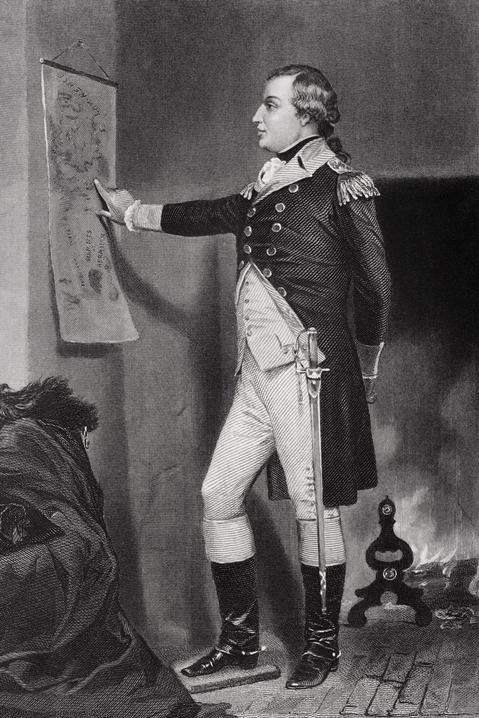
Richard Montgomery is best known as a hero of the Revolutionary War. The former British army officer who gave his life leading his men in a heroic charge against the walls of Quebec. His wife, Janet Livingston Montgomery, was left a saintly widow the keeper of her husband’s memory.  
But this post isn’t about that.
The much romanticized Death of Montgomery 

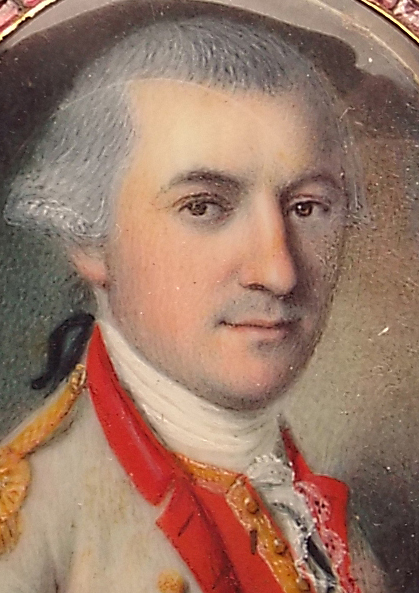
Richard Montgomery 
This post is about Montgomery the man. The Montgomery, who after experiencing some of the worst fighting and conditions imaginable in the French and Indian War returned to Ireland to recover his health. There he met a woman who struck his fancy. They engaged in a relationship in which they enjoyed connubial bliss without actually marrying.

That is until 1769. I’ll let Montgomery tell you what happened next with a passage from a letter he wrote to a friend; “in short she has clapped me” She gave him the clap.

Gonorrhea.

Montgomery was understandably upset. He wrote, “I have touched no other woman” which seems to indicate this mystery lady was less inclined to monogamy than he was . His “indignation and rage” were so great that he considered abandoning the woman with pocket change but instead as “the flames of my passion have subsided with those of my urine” he settled her with seventy pounds a year.

The end of this story brings up a great many questions. Who was this woman? Had Montgomery intended to marry her? Why did he feel the need to pay her so much money? Was there a child involved?  These questions may never be answered.

Neisseria gonorrhoeae 
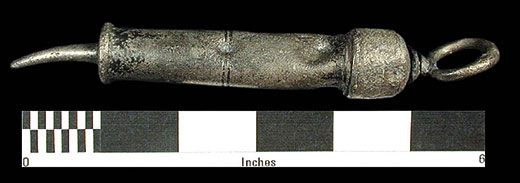
What is known is that Gonorrhea had no cure in the 18th century. According to the CDC Neisseria gonorrhoeae is a bacterium that infects the mucus membranes of the reproductive tract. Its symptoms include pain, discharge from the urethra, painful or burning urination (which Montgomery clearly had) and cysts on the skin of the effected area. Untreated it could lead to sterility in both men and women. Today Gonorrhea is treated with antibiotics. In Montgomery’s time treatments were few. Mercury injected into the urethra was used for both Gonorrhea and Syphilis. For men, the French were known to “clap” or hit from both sides an appendage with a cyst to get rid of it. (This is one possible source for Gonorrhea’s nickname “the clap” and really, really horrible to think about)

This syringe for injecting mercury into the Urethra
was found in Blackbeard\’s wrecked ship


Since there was no way that Montgomery could have gotten rid of his Gonorrhea by the time he married Janet Livingston in the drawing room at Clermont in 1773 and there is no indication that they did not conjugate their marriage, it stands to reason that he passed the clap on to his wife. 

This may have been a part of why she never married again. Without dismissing the affection, she felt for Montgomery remarrying would also have led to humiliation for her and him. A new husband on discovering that he had been “clapped” could only come to two conclusions; that Janet was loose in her morals and we can see that type of reaction from Montgomery to his initial infection or that Richard Montgomery had been a bit free with himself and infected not only himself but his wife. This would surely have caused a scandal because immediately after his death Montgomery was so lionized by the colonies. The first monument that Congress ever voted to build was a monument to Montgomery and later editions of Common Sense by Thomas Paine featured an appearance by Montgomery’s very patriotic ghost.

Richard Montgomery is remembered today as the leader of the invasion of Canada and a hero of the Revolution, but he was a man. A man with a “disagreeable companion” which affected his life and Janet’s since; perhaps, had he not gotten the clap he would have married his mystery woman and stayed in England,. Her decisions about love and marriage after Montgomery’s death were probably at least partially influenced by the condition that her husband had shared with her and a need to protect both her reputation and his. [i]

Now aren\’t you glad I didn\’t add more pictures?

[i]The letter in which Richard Montgomery talks about his venereal disease belongs to the Montgomery Collection at the William L. Clements Library at the University of Michigan.

I should also give credit to Rick Atkinson’s excellent book The British are Coming which was the means by which I became aware of the existence of the letter this blog is based on.

We\'ve Done This Before

\”His Rotundity\”
John Adams’ term as President is not a high point of American history. In fact, with the Alien and Sedition Acts, he and the Federalists managed to pass some of the most un-American legislation in history. Forget four score and seven years, the Federalists could not wait twenty years before they tried to create a dictatorship.
          The Alien and Sedition Acts essentially allowed John Adams to imprison or fine any one he wanted. Specifically, the Sedition Act allowed the President to imprison or fine anyone who criticized the government. The Alien Acts allowed for the imprisonment or fining of anyone born in another country. The Naturalization Act, which is also lumped in with this other nonsense, raised the years of residency from five to fourteen in order to become a citizen of the country.
          The Federalists claimed that new immigrants were harming the country. European radicals were coming to America to start the next French Revolution! As one oft quoted though stubbornly anonymous congressional Federalist is said to have exclaimed that there was no need to “invite hordes of Wild Irishmen, not the turbulent and disorderly of all the world to come here with a basic view to distract our tranquility.”[i] The truth of course was that new immigrants had proven more likely to vote for the Democratic-Republican party and the Federalists had to do something about the erosion of their power.
Its there. Look close.
          So why was this attempt to discourage immigration so un-American? Let’s take a look at the Declaration of Independence. You know the document that John Adams supposedly helped to write? Although the fact that he signed these Acts into law makes one wonder if he ever even read it. After you get past the Life, Liberty and Pursuit of Happiness part, the Declaration becomes a list of complaints against King George III. One of them reads as follows:
“He has endeavoured to prevent the population of these States; for that purpose obstructing the Laws for Naturalization of Foreigners; refusing to pass others to encourage their migrations hither, and raising the conditions of new Appropriations of Lands.”
To put it simply, the idea the immigrants are welcome here, necessary here, is one of the founding principles of the United States of America. Unanimous, indisputable, right there on the parchment.
When the Alien Friends Act was read before Congress in May of1798, Edward Livingston gave it a stinging, three-hour long rebuke on the floor. Newspaper accounts of his speech would take up ten full columns. This earned him the scorn of Abigail Adams who wrote; “we want more Men of Deeds, and fewer of Words.”[ii]Of course the Adams had hated the Livingstons for more than two decades at this point and Abigail was always quick to defend her husband.
         

And he did need defending. In the speech Edward Livingston called out the Federalist party for trying to “complete the picture of tyranny” by giving John Adams the power to dispose of his enemies with no oversight. Several journalists were imprisoned or fined under the Sedition Act for criticizing Adams’ administration. The Alien Act would allow him to do the same to others based solely on their place of birth and the President’s “present interest or passion”

          Having shown over the course of his three-hour lecture that the bill was “at war with the fundamental principles of our government” Livingston and the other Democratic-Republicans could only hope they had swayed enough of the majority Federalists that the bill would not move forward. They had not and the bill moved on and was eventually signed into law.
          What were the implications of this? In the short term, John Adams lost his

reelection bid in 1800 making him the first president voted out of office for attempted despotism. Thomas Jefferson became president and most of the acts were allowed to expire. The imprisoned were released and fines were eventually returned.

Did I fucking stutter?
          The Alien Enemies Act languished on the books for more than a century. Then another particularly virulent cycle of xenophobia hit, and the Act was dusted off by Franklin Delano Roosevelt during World War II. He used it to round up Japanese Americans and Japanese immigrants and put them in concentration camps. This action has been almost universally condemned.
          It is a sad fact that throughout the history of the United States of America fearmongers have used the threat of a dangerous “other” to garner more power for themselves. America has always been fortunate though that there have been good people to stand up and fight when xenophobes try to seize power.

[i] This quote appears in almost all articles about the Alien and Sedition Acts but I have been unable to identify the speaker as of yet. Does any one have any more information?

[ii] “Abigail Adams to William Smith, 10 June 1797,” Founders Online, National Archives, accessed April 11, 2019, https://founders.archives.gov/documents/Adams/04-12-02-0095. [Original source: The Adams Papers, Adams Family Correspondence, vol. 12, March 1797 – April 1798, ed. Sara Martin, C. James Taylor, Neal E. Millikan, Amanda A. Mathews, Hobson Woodward, Sara B. Sikes, Gregg L. Lint, and Sara Georgini. Cambridge, MA: Harvard University Press, 2015, pp. 154–156.]

"Tired With Being There" Henry Beekman Livingston\'s Brief Time as a Guest of the British Navy

As he took stock of his situation after the Battle of Saratoga General Horatio Gates felt the need to address the situation to his south. While Gates and the Northern Army had been drubbing General John Burgoyne, General Sir Henry Clinton had launched an attack up the Hudson River Valley, taking Forts Clinton and Montgomery, burning Kingston, burning Clermont and a number of other private homes. Gates found this offensive and let Clinton know it in a harshly worded letter.

A perfect choice for messenger boy
          To deliver the letter Gates sent Colonel Henry Beekman Livingston of the 4thNew York Regiment who had a personal stake in the matter as the British had burned down his mother’s house in their attack. Gates ordered Henry to find the enemy at Fort Montgomery, assuming that they would have occupied the fort after they had taken it. They had not, choosing instead to return to New York City.
          Henry, of course, decided to exceed his orders and headed south. At King’s Bridge he was taken aboard the H.M.S. Mercuryunder the command of James Montagu. Montagu immediately passed Henry off on his first officer Lieutenant Logan.
James Montagu\’s statue in West Minster Abbey
          Lt. Logan took Gage’s message from Henry and sent it ashore. As for Henry he now found himself a sort of guest, sort of prisoner on the ship. While he was not put in chains he had very little in the way of freedom while he waited for an answer to his message. He could not set foot ashore. Henry described his treatment as “very Indifferent.”

Henry Clinton, not great at checking his messages

          After two days aboard the ship it appears that Montagu and Henry had begun to get on each other’s nerves. Henry was constantly bombarding Montagu and Logan with demands to send more messages to Clinton or for answers as to why he had not had an answer yet. Finally,Henry demanded to send another message to Clinton, from whom he was yet to receive a response and Montagu refused to offer him any more help. Henry was “Tired of being here.”
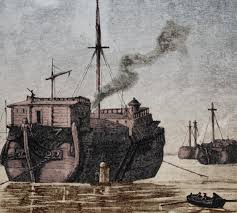
          It was time for Montagu to get rid of Henry. He could have simply turned him over to one of the prison hulks in New York Harbor, but for a pesky sense of honor. Henry had traveled under a flag of truce so Montagu put Henry ashore back at King’s Bridge.

HMS Jersey, the most famous prison hulk

How many ships did you sink?


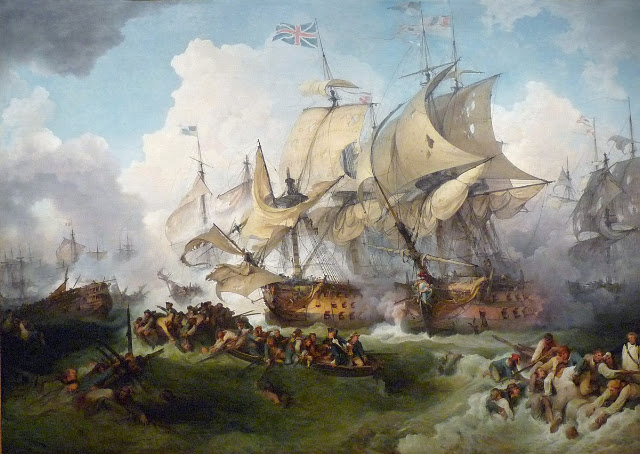
This allowed Henry to return to his regiment in time to join them at Valley Forge and serve in the army for another year. On Christmas Eve of 1777 Montagu ran the H.M.S. Mercury into a sunken obstacle in the Hudson River and lost her. The obstacle had been placed by the Americans, maybe by the Committee to Defend the River of which Henry\’s brother Robert R. Livingston was a member. He would have a rather unimpressive career after that until June 1, 1794 when he was killed at the Battle of Ushant, the Glorious First of June during the Napoleonic Wars.[i]

Not shown, James Montagu getting hit by a cannon ball early in the battle.


[i] Henry Beekman Livingston wrote a report on his journey south to George Clinton on November 13, 1777.  The letter is now in the New York State Archives Henry Livingston Papers collection.
Not that George Clinton

Perishing in the Field: Henry Beekman Livingston at Valley Forge

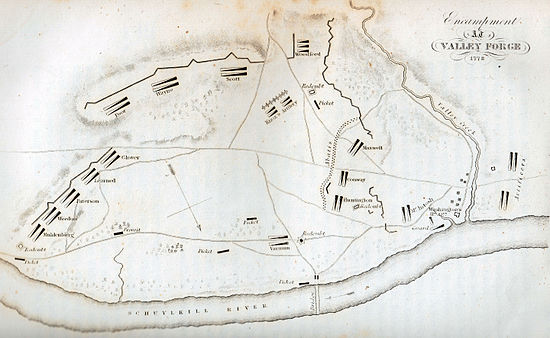
It would be tough to decide which members of the Livingston family had the worse Christmas in 1777. Chancellor Robert R. Livingston had suffered the destruction of his house by the British Army and was forced to take Christmas dinner at his cousin Peter R. Livingston’s house. Margaret Beekman Livingston, who had also lost her home to the British was in Connecticut staying at a house that belonged to Robert Livingston, 3rdLord of Livingston Manor. On the other hand, Henry Beekman Livingston was settling in to his winter quarters with the Continental Army at Valley Forge, Pennsylvania.

After being briefly held by the British as a quasi-prisoner of war in November of 1777 Henry rejoined his regiment, the 4thNew York, in time to join them in winter quarters. On December 24, 1777 Henry, had written to his brother Robert; “We are now building huts for our winter quarters without tools or nails so I suppose we may render ourselves very comfortable by the time winter is over.” He went on to explain that his men were \”in general mostly naked and very often in a starving condition.\” He and his troops were lousy with bugs and only 18 men could muster fully clothed, the rest missing shoes, stockings, coats or breeches[i]

The huts may have looked something like this reproduction

Christmas Day did not show much improvement for the men in Valley Forge. George Washington’s general orders to the army begin with order 9 men from each brigade and three wagons to be assigned “for the purpose of collecting flour, grain, cattle and pork, for the army.” They end with a warning against plundering the local inhabitants and that anyone caught was to be “severely punished.”[ii]This would seem to indicate a shortage of food and possibly other supplies in the camp.
Not this George Clinton
This one

Henry wrote to Governor George Clinton of New York that day. He wrote; “Wholly destitute of clothing, the men and officers are now perishing in the field at this season of the year, and that at a time when troops of almost every other state are receiving supplies of everything necessary and comfortable.”[iii]

Harry and his men made it through Christmas though many of them would fall sick over the course of the winter. Henry himself fell so ill he had to be removed from the camp to a private house several miles away. He soon recovered though, boasting, in a letter to George Washington, that he had “never been sick before in My Life that I shall be enabled to return to my Duty in a few days.”[iv]
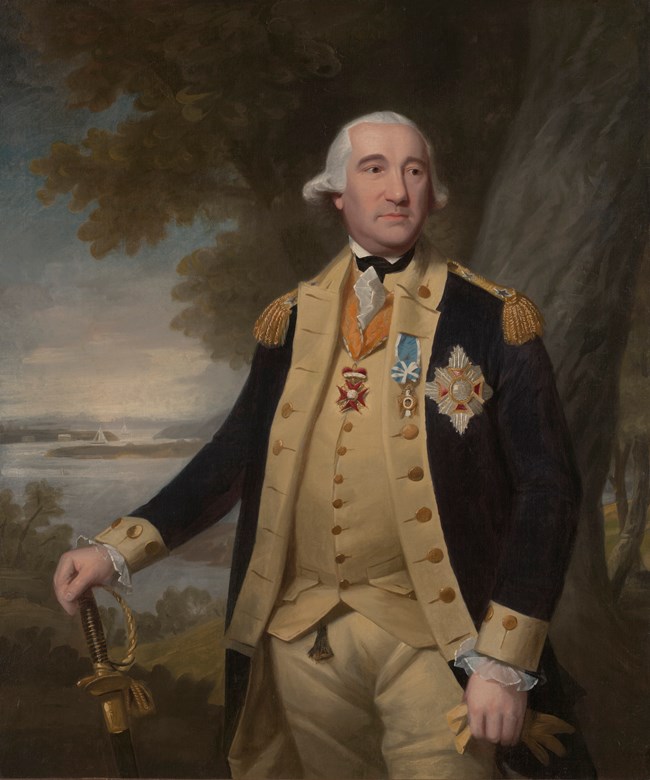
The \”Prussian Lieutenant General\” von Steuben

 It turned out that it would take Henry six weeks to recover. By the end of March 1778 he was back in camp with his regiment learning how to be a real soldier. Over the next few months Henry and his men trained extensively under the Baron von Steuben who Henry described as \”an agreeable man\”. Henry found the training \”more agreeable to the dictates of reason and common sense than any mode I have before seen,\”[v] 
In June of 1778 Henry Beekman Livingston, the 4th New York and the entire Continental Army emerged from their winter quarters at Valley Forge transformed. They were an army that could stand in the field against the British Army . Still though, Christmas 1777 was pretty bad.

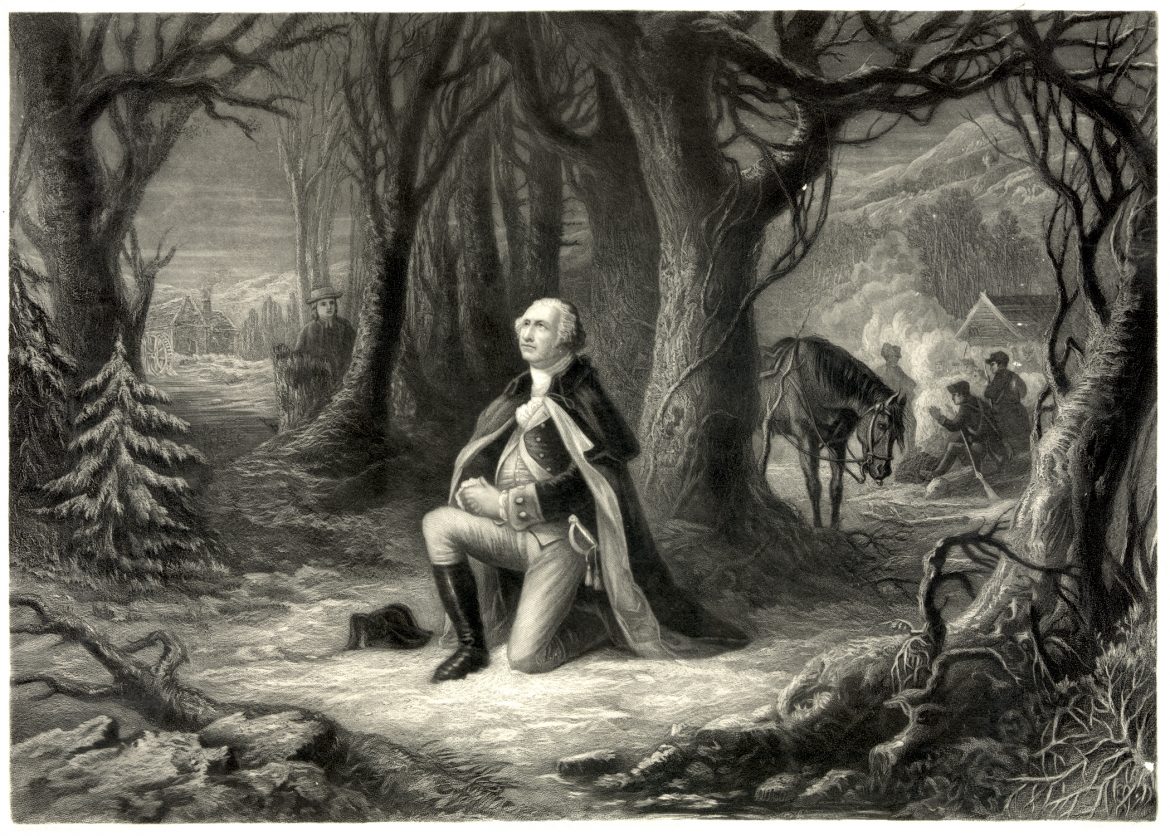
A copy of this apocryphal image hangs in the study at Clermont supposedly showing George Washington praying for his troops at Valley Forge.


[i] Boyle, Joseph Lee Writings from the Valley Forge Encampment December 19,1777- June 19, 1778 Volume 2. Heritage Books, Maryland 2007 p 2.
[ii] “General Orders, 25 December 1777, ”Founders Online, National Archives, last modified June 13, 2018, http://founders.archives .gov/documents/Washington/03-12-02-0647.
[iii] Public Papers of George Clinton Volume II Published by the State of New York, Wynkoop Hallenbeck Crawford Co, New York, 1900, p 605-606
[iv] “To George Washington from Colonel Henry Beekman Livingston, 10 February 1778,” Founders Online, National Archives, last modified June 13,2018, http://founders.archives.gov/documents/Washington/03-13-02-0417
[v] ] Boyle, Joseph Lee Writings from the Valley Forge Encampment December 19,1777- June 19, 1778 Volume 2. Heritage Books, Maryland 2007 p 92-94

The Boy in the Soldier\'s Coat: Eugene Livingston and the Civil War

 The American Civil War was hell. Per the American Battlefield Trust there were more than a million casualties during the war. 620,000 men died because of battle or disease. Most of these men didn’t die the quick, painless, glorious deaths seen in paintings and movies. They died screaming for their mothers on bloody,  battlefields stinking of fear and shit or feverish in sick bed slowly succumbing to disease. Such is the story of Eugene Livingston.

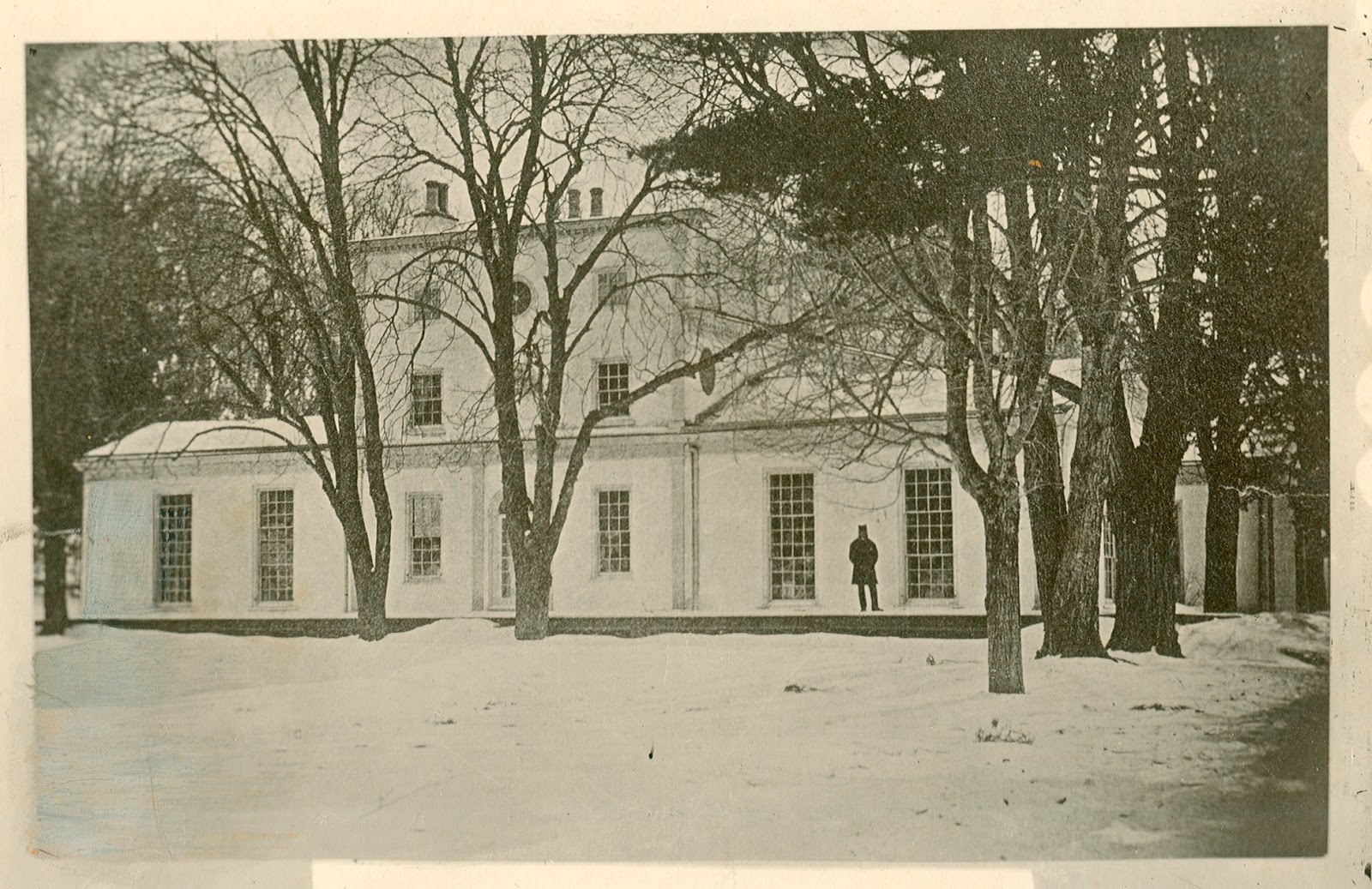
Aryyl house in 1869
          Eugene Livingston was born on January 6, 1845 in Philadelphia. His parents were Eugene Augustus Livingston and Harriet Coleman. Eugene Augustus was the son of Robert L. and Margaret Maria Livingston, He would have spent at least part of his childhood at Arryl House, formerly the home of his grandfather Chancellor Robert R. Livingston and now the home of his brother, Montgomery Livingston.
Teviot
          Eugene Augustus and Harriet soon made a home at Teviot, the Hudson River estate immediately south of Clermont. Harriet gave birth to a daughter they named Mary Coleman Livingston. Unfortunately, Harriet died shortly thereafter. Eugene Augustus married Elizabeth Rhodes Fisher in 1851.
          At the same time the country was falling apart. Following the election of 1860 and the inauguration of Abraham Lincoln as president, eleven southern slave holding states illegally withdrew from the union and revolted against the United States.
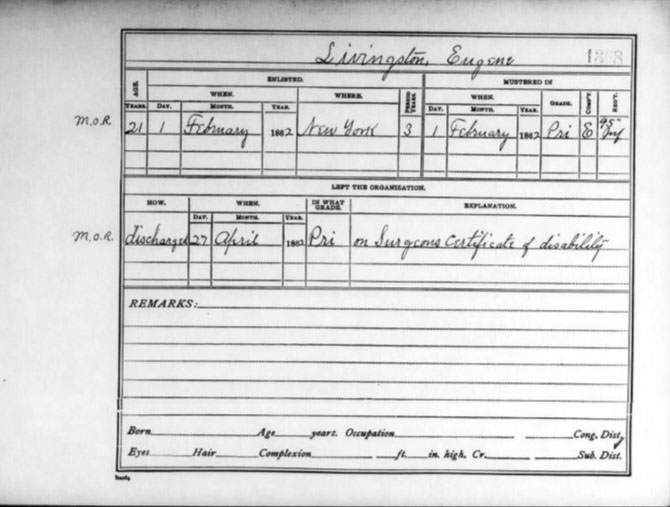
Eugene Livingston\’s enlistment record from the National Archives
          The war was expected to end quickly but after a humiliating defeat at the First Battle of Manassas the Union ramped up recruitment for the army as well as production of war materials.
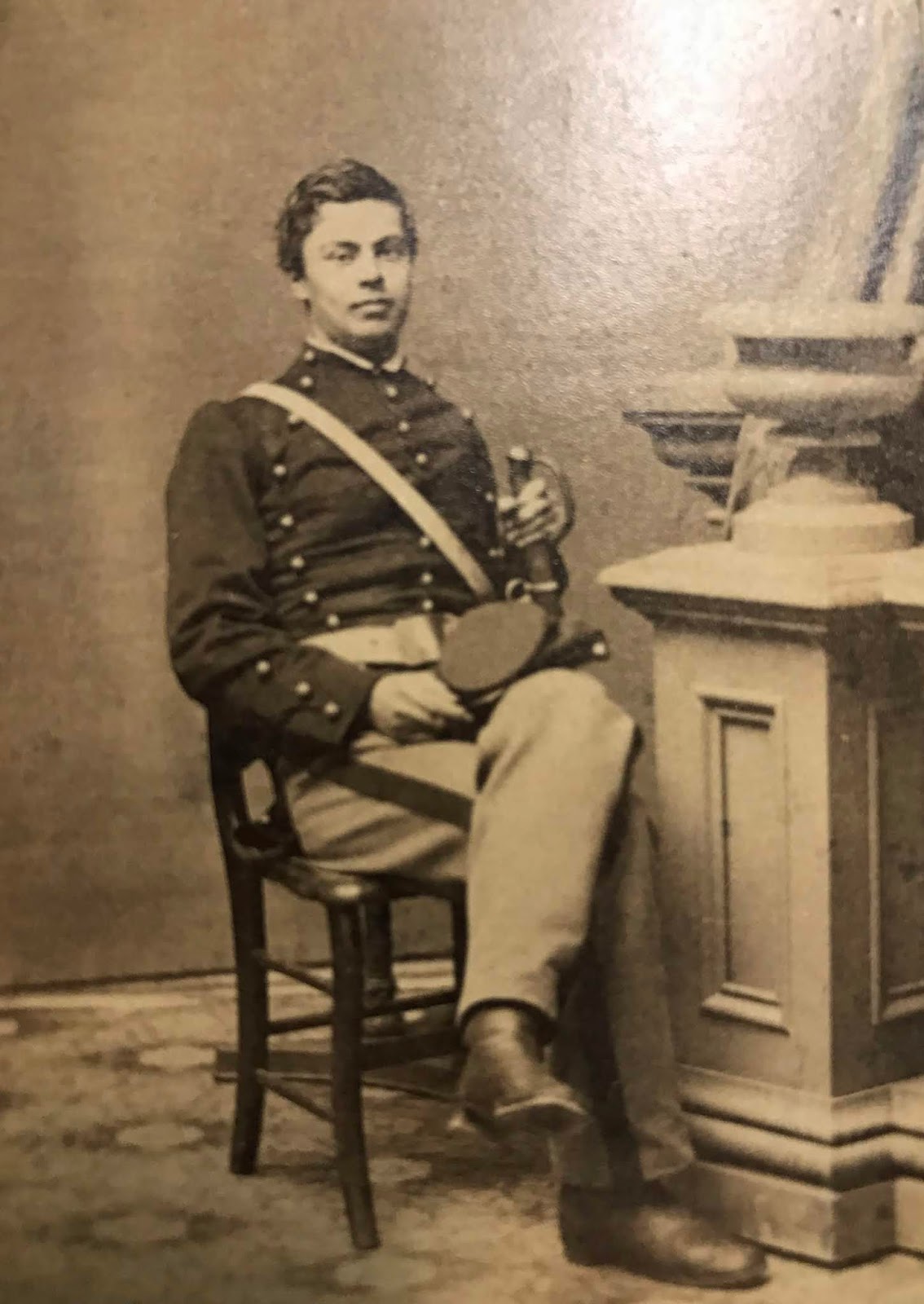
          On February 1, 1862, the younger Eugene enlisted in the 95th New York Infantry and was mustered in that same day. He lied about his age. He was 17 but his enlistment record says he was 21. We do not know what inspired Eugene to enlist. Perhaps he felt strongly about saving the Union or ending slavery. Perhaps he was worried about being called a coward if he did not fight. Perhaps he was inspired by stories of his famous ancestors. Whatever his reasons, Eugene gave up his life of comfort and safety on the Hudson River to join a brutal war.   
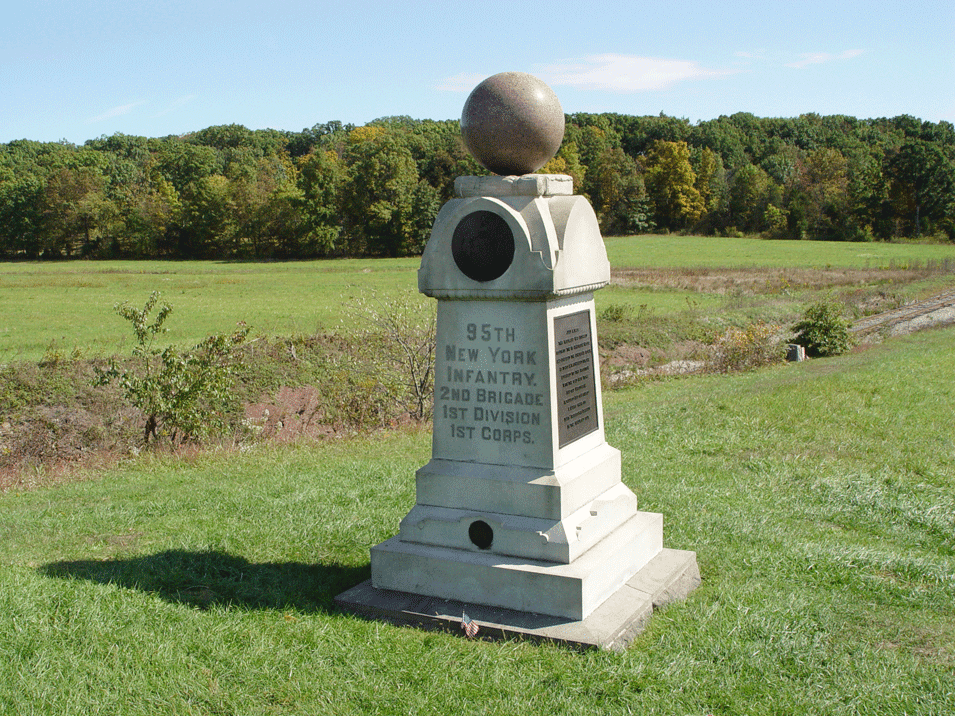
Monument to the 95th Regiment at Gettysburg
The 95th would go on to see some of the most intense fighting of the Civil War. They served at; The Second Battle of Manassas, Antietam, Gettysburg, Chancellorsville, Spotsylvania and Appomattox. Eugene saw none of this. 
         On March 8, 1862 Eugene posed for a photo in uniform. Ten days later his regiment finally left New York City. They were assigned to help defend Washington D.C. Shortly after arriving in the capital Eugene fell sick with Tuberculosis. On April 27, 1862, he was discharged from the army with a surgeons’ certificate of disability.
Eugene Livingston
          Eugene never recovered his health. He returned to his father’s house, Teviot, hoping the country air would cure his consumption. It did not. On Wednesday December 31, 1862 Eugene died at Teviot, a week short of his 18th birthday.
In the untimely loss of your noble son, our affliction here, is scarcely less than your own. So much of promised usefulness to one\’s country, and of bright hopes for one\’s self and friends, have rarely been so suddenly dashed, as in his fall.

Abraham Lincoln, May 25, 1861 Letter to Ephraim D. and Phoebe Ellsworth

Great Britain has never paid much attention to rights which interfere with her Views: Newfoundland and the American Revolution


Captain James Cook\’s 1775 chart of Newfoundland

  Newfoundland and its associated fishing grounds were among the most valuable properties in the new world. France and Britain had long warred over the islands. Spain tried to claim a share of the fishing trade and Basque fishermen used the fishing grounds for hundreds of years. The French had largely been forced off the island by the 1713 Treaty of Utrecht, which ended the War of Spanish Succession, although they still held the islands of St. Pierre and Miquelon just a few miles off the south coast of Newfoundland. At the end of the French and Indian War these two small islands were France’s only holdings in North America.

As valuable as the island and its fishing was, the British government long discouraged permanent settlement on the island, preferring instead a mainly migratory population that followed the fishing trade. The fishing trade was

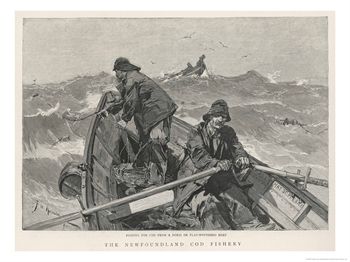
Fishing was a little different then

estimated to be worth about £600,000 per year. The island’s position on the globe also meant that’s its ports offered safe harbor during Atlantic crossings.

          The impact of the troubles in the thirteen American colonies was felt in Newfoundland before the actual fighting broke out. As mentioned before Newfoundland had a largely migratory population and needed to be provisioned from elsewhere. Boston became the primary supplier of provisions to Newfoundland and acted as a middleman in the trade of fish with the West Indies. Fisherman sent fish south and rum and molasses made their way north.
          Following the imposition Intolerable Acts of 1774, which shut down the port of Boston and imposed many other limitations on trade in the colonies in response to the Boston Tea Party and other troubles, the colonies declared an embargo on trade with the British. This included Newfoundland. When the fishing fleets arrived that summer, they found no supply of bread and flout to keep them fed. What had not arrived from the colonies could not be replaced from England or from Quebec although attempts were made.
          With the outbreak of the shooting war in 1775 the food shortage did not improve. The price of flour and bread tripled, people went hungry and there were reports of some starving to death. This led to more attempts at farming on the island and several people leaving their small outports and heading for the larger population centers like St. Johns.
          Many Americans saw the value of disrupting the British fishery at Newfoundland. Only the lack of a navy of any size prevented a full-on attack on the

Vice Admiral John Montagu

island. Vice-Admiral John Montagu, commander of the Newfoundland station, had only four ships and a few smaller armed vessels to attempt to defend the coast, the Grand Banks fishing grounds and to disrupt American shipping to Europe. This meant that American privateers could wreak havoc almost at will. Most privateers were after the profit of capturing a British merchant vessel so the small fishing ships were not valuable targets in and of themselves but taking a fishing ship allowed privateers to resupply their stocks of food, water, naval stores and in some cases even men. They also began to attack the small outport villages on the southern coast of Newfoundland.

          The presence of American privateers seriously cut into the fishing off Newfoundland. In addition, the threat of impressment onto the British men of war stationed at Newfoundland or making an Atlantic crossing gave even more incentive to fishermen to stay off the seas. For the first time the resident population of Newfoundland exceeded the

Privateer

migratory population.[i]

          The entrance of the French into the war brought a whole new level of importance to Newfoundland. Shortly after receiving news of the new alliance in 1778, Admiral Montagu took his small force and conquered St. Pierre and Miquelon. The islands had no defenses and were of little value but it really was a thumb in the eye to the French. This led Count D’Estaing to write to George Washington that he had heard the islands had been ravaged and that “We hope that with your assistance the day will come, when France shall partake the Cod-fishery with other nations.”[ii]
          Benjamin Franklin also caught on to the French interest in Newfoundland. On February 25, 1779, he suggested an attack on Nova Scotia and Newfoundland say “Halifax being reduced, the small forts of Newfoundland would easily follow…” He also stated that the fishery was a source of money for the British and “a great Nursery of Seamen.” A place where the British could man their naval vessels with experienced sailors.[iii]
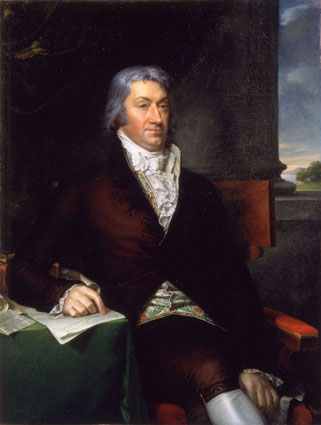
          When the English government finally got serious about negotiating a peace treaty to end the war the rights to fish around Newfoundland were not only incredibly important to the Americans, but a major sticking point for the British. On January 7, 1782, Robert R. Livingston, who had the unenviable task, as Secretary of Foreign Affairs, of trying to supervise the peace negotiations in Paris

Just when you were wondering what this blog had to do with anything  

from Philadelphia wrote to negotiator Benjamin Franklin; “The fisheries will probably be a source of Litigation, not because our rights are doubtfull, but because Great Britain has never paid much attention to rights which interfere with her Views.”

He went on to explain more fully:
The Arguments of which the People of America found their claim to fish on the Banks of Newfoundland, arise first from their having once formed a part of the British Empire, in which State they allways enjoyed as fully as the People of Britain themselves, the right of fishing on those banks. They have shared in all the Wars for the extension of that right, and Britain could with no more justice have excluded them from the Enjoyment of it (even supposing that one Nation could possess it to the exclusion of an other) while they formed a part of that Empire, than they could exclude the People of London or Bristol. If so the only enquiry is how have we lost this right, if we were Tenants in Common with Great Britain while United with her, we still continue so, unless by our own Act we have relinquished our Title. Had we parted with mutual Consent, we should doubtless have made partition of our common Rights by Treaty. But the oppressions of Great Britain forced us to a seperation, (which must be admitted, or we have no right to be independant) it cannot certainly be contended that those oppressions abridged our Rights or gave new ones to Britain, our rights then are not invalidated by this seperation, more particularly as we have kept up our Claim from the commencement of the War, and assigned the attempt of Great Britain to exclude us from the fisheries as one of the causes of our recurring to Arms.
The second Ground upon which we place our right to fish on the Banks of Newfoundland provided we do not come within such distance of the coasts of other powers as the law of Nations allows them to appropriate, is the right which Nature gives to all Mankind to use its common Benefits, so far as not to exclude others. The Sea cannot in its nature be appropriated. No Nation can put its mark upon it, Tho’ attempts have sometimes been made to set up an Empire over it, they have been considered as unjust usurpations, and resisted as such in turn by every Maritime Nation in Europe.[iv]
Interestingly, in November of 1782, John Adams used a nearly identical

John Adams and his \”original\” ideas

argument during a negotiation session with British agents. As he recounted in his diary:

When God Almighty made the Banks of Newfoundland at 300 Leagues Distance from the People of America and at 600 Leagues distance from those of France and England, did he not give as good a Right to the former as to the latter. If Heaven in the Creation gave a Right, it is ours at least as much as yours. If Occupation, Use, and Possession give a Right, We have it as clearly as you. If War and Blood and Treasure give a Right, ours is as good as yours. We have been constantly fighting in Canada, Cape Breton and Nova Scotia for the Defense of this Fishery, and have expended beyond all Proportion more than you. If then the Right cannot be denied, Why should it not be acknowledged? and put out of Dispute? Why should We leave Room for illiterate Fishermen to wrangle and chicane?       [v]
It seems reasonable that Adams may have seen Livingston’s letter to Franklin at some point but the terrible relationship between the two men would never have allowed Adams to give any credit to Livingston for the ideas.
          Ultimately the Treaty of Paris was finalized in 1783 and signed. It consisted of ten articles. The first was America independence from Great Britain. The second defined the borders of the new United States. The third reads thusly:
It is agreed that the People of the United States shall continue to enjoy unmolested the Right to take Fish of every kind on the Grand Bank and on all the other Banks of Newfoundland, also in the Gulph of St. Lawrence and at all other Places in the Sea where the Inhabitants of both Countries used at any time heretofore to fish. And also that the Inhabitants of the United States shall have Liberty to take Fish of every kind on such Part of the Coast of Newfoundland as British Fishermen shall use, (but not to dry or cure the same on that Island) and also on the Coasts Bays & Creeks of all other of his Britannic Majestys Dominions in America, and that the American Fishermen shall have Liberty to dry & cure Fish in any of the unsettled Bays Harbours and Creeks of Nova-Scotia, Magdalen Islands, and Labrador, so long as the same shall remain unsettled, but so soon as the same or either of them shall be settled, it shall not be lawful for the sd: Fishermen to dry or cure Fish at such Settlement, without a previous Agreement for that purpose with the Inhabitants, Proprietors or Possessors of the Ground.[vi]
After independence, a share of the fishing trade was considered one of the most important objectives of the American negotiators. Its not until the 7th article that they actually get around to ending hostility and stopping the war.

It was all about this beautiful, majestic, delicious creature

          The importance of Newfoundland to America cannot be overstated. The territory would flare up again during the quasi-war with France at the end of the 18th century. In the 19th century fisherman from all over the east coast, including the City of Hudson would sail for the Grand Banks. At the beginning of World War II Franklin Delano Roosevelt traded a bunch of broken down destroyers to the British for the rights to put a base on Newfoundland. The base ended up operating throughout the war and the rest of the 20th century, only being scaled down in the 1990’s. It seems that this rocky island has inextricably connected to the fate of the United States.


[i]Much of this information come from several ariticles by Olaf Janzen publish on www.heritage.nf.ca and to Olaf Janzen’s article JANZEN, OLAF. \”The Royal Navy and the Defence of Newfoundland during the American Revolution.\” Acadiensis 14, no. 1 (1984): 28-48. http://www.jstor.org/stable/30303382.
[ii] “To George Washington from Vice Admiral d’Estaing, 6 October 1778,” Founders Online, National Archives, last modified June 13, 2018, http://founders.archives.gov/documents/Washington/03-17-02-0295. [Original source: The Papers of George Washington, Revolutionary War Series, vol. 17, 15 September–31 October 1778, ed. Philander D. Chase. Charlottesville: University of Virginia Press, 2008, pp. 279–280.]
[iii] “From Benjamin Franklin to Vergennes: Two Letters, 25 February 1779,” Founders Online, National Archives, last modified June 13, 2018, http://founders.archives.gov/documents/Franklin/01-28-02-0515. [Original source: The Papers of Benjamin Franklin, vol. 28, November 1, 1778, through February 28, 1779, ed. Barbara B. Oberg. New Haven and London: Yale University Press, 1990, pp. 603–607.]
[iv] “To Benjamin Franklin from Robert R. Livingston, 7 January 1782,” Founders Online, National Archives, last modified June 13, 2018, http://founders.archives.gov/documents/Franklin/01-36-02-0267. [Original source: The Papers of Benjamin Franklin, vol. 36, November 1, 1781, through March 15, 1782, ed. Ellen R. Cohn. New Haven and London: Yale University Press, 2001, pp. 390–402.]
[v] “1782 November 29. Fryday.,” Founders Online, National Archives, last modified June 13, 2018, http://founders.archives.gov/documents/Adams/01-03-02-0001-0004-0023. [Original source: The Adams Papers, Diary and Autobiography of John Adams, vol. 3, Diary, 1782–1804; Autobiography, Part One to October 1776, ed. L. H. Butterfield. Cambridge, MA: Harvard University Press, 1961, pp. 79–81.]
[vi] “Definitive Treaty of Peace between the United States and Great Britain, 3 September 1783,” Founders Online, National Archives, last modified June 13, 2018, http://founders.archives.gov/documents/Franklin/01-40-02-0356. [Original source: The Papers of Benjamin Franklin, vol. 40, May 16 through September 15, 1783, ed. Ellen R. Cohn. New Haven and London: Yale University Press, 2011, pp. 566–575.]

Long Island Harry

Henry Beekman Livingston 
In the summer of 1776 Lt. Col. Henry Beekman Livingston was sent with three companies of the 2ndNew York Regiment to guard the Eastern end of Long Island. In July Henry wrote to George Washington to explain the disposition of his troops. He had assigned one company to Montauk Point, one to Shelter Island and one to Oyster Pond Point (present day Orient Point.) He was guarding more than 1,600 cattle, 500 horses and 10,000 sheep. The local committee of safety had given him two canons but no ammunition for them. He hoped Washington could send him some because he felt “they would be of Service to us in the Enemy Should ever take it in their Heads to visit us.”[i]
            On July 20th Nathaniel Woodhull, a member of the New York Convention and a general of the Long Island militia wrote to Washington. At the end of his letter he asked that Henry and his men be left at their current post and not removed. He feared “the Inhabitants would totally abandon the Country should those troops be drawn off.”[ii]This was a fear that Henry shared and the loyalty of the citizens of Long Island would play a major role in the events of the next couple of months. The British fleet had arrived in New York Harbor in early July. Everyone was holding their breath to see where the British would attack.

32,000 troops in New York Harbor

\”I\’ve got the weirdest feeling we forgot something\”
            On August 22, 1776, the British began landing on Long Island near present day Brooklyn, on the other end of Long Island from Henry’s position. By the end of the month the British had pushed Washington and the main army off Long Island, leaving Henry and his men trapped behind enemy lines.
            All the while Henry was receiving intelligence about what was happening on the west end of the island he held his post. On August 30, he watched, what he took to be, three British frigates, a brig and a sloop sail into Long Island Sound. He realized that “Communication by water between this and New York is now cut off.” Henry offered to attack the British rear if he could have reinforcements from Connecticut. The country was exposed to the “Ravages” of the enemy and he was seeking orders.[iii]
            Henry wrote to Washington again the very next day. The situation was getting worst. The British ships were still in the sound, General Woodhull had been wounded and captured by the British (he would later die of his wounds) and British horsemen were disarming the population. Henry began to march his men west hoping to raise the local militias as he went and perhaps attack the British.[iv]

Right before Woodhull accidentally fell on that soldiers
sword over and over again

            On September 4th, Washington finally had a calm moment to write back to Henry. He was not encouraging. He wrote: “it is not in my power to give you any instructions for your Conduct…” He encouraged Henry to deny the British forage but ultimately left Henry’s fate up to Henry.[v]
            Henry had not idle while waiting to hear from Washington. As he marched west, he had gathered about 150 militia men.  Unfortunately, they all deserted when they heard that Washington had abandoned Long Island. At about the same time he received a letter from the people of the town of Huntington, begging him to “for Gods Sake” not advance toward their town as they had already surrendered to the British and feared that the presence of his men would cause the British to destroy the town.
            Henry saw that his options were getting slimmer and slimmer. He began to retreat. Along the way, he disarmed any loyalists he found. By the time, he was ready to cross the Long Island sound to Connecticut he had gathered 236 small arms, 6 canons, 5 casks of gunpowder, 2 and ½ boxes of musket balls, 190 cartridge boxes, 160 full powder horns and 153 bayonets.[vi]
           

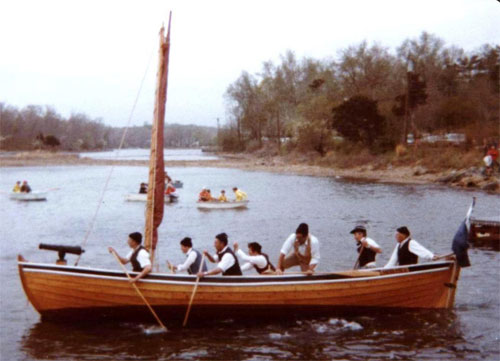
A replica of the type of boats Henry and his men used to
cross Long Island Sound. Not shown: sea sick sheep.

Henry and his men loaded into whale boats, somehow avoided the British navy and made it to Connecticut on September 2. He immediately began planning a return to Long Island. Shortly after writing his letter to Washington on September 11, Livingston and his men rowed back to Long Island. They landed at Shinnecock and carried off 3,129 sheep and 400 cattle. One of his companies also headed into Setauket, to break up a tory militia that was forming there. They attempted to arrest the captain of the Tories, Richard Miller Jr., but he resisted and was shot. He soon died of his wounds. 

Don\’t let the doe eyes fool you, Oliver Delancey Jr
would put a price on you.
            This raid proved to be too much for another loyalist, Oliver Delancey. The Delanceys had been long time political foes of the Livingston family. Because of this raid, Oliver Delancey put a bounty of 500 pounds on Harry’s head. Harry offered to put the same price on Delancey’s head if Washington agreed.[vii]
            Henry’s time on Long Island was reaching its end though. During October of 1776 Henry worked on a plan for a large raid on Long Island involving his troops as well as troops from Connecticut and Massachusetts. He had Washington’s full support but when the whale boats he had been promised failed to show up it appears the plan was aborted. In November of that year Henry was promoted to colonel and given command of the 4th New York Regiment in the Hudson Highlands. His duties carried him away before he had a chance to further harass the British on Long Island.

[i] “To George Washington from Lieutenant Colonel Henry Beekman Livingston, July 1776” Founders Online, National Archives
[ii] “To George Washington from Nathaniel Woodhull, 20 July 1776” Founders Online, National Archives.
[iii] “To George Washington from Lieutenant Colonel Henry Beekman Livingston, 30 August 1776” Founders Online, National Archives
[iv] “To George Washington from Lieutenant Colonel Henry Beekman Livingston, 31, August 1776” Founders Online, National Archives.
[v] “From George Washington to Lieutenant Colonel Henry Beekman Livingston, 4 September 1776” Founders Online, National Archives. I couldn’t find any reference to Washington agreeing to a price on Delancey’s head.
[vi] To George Washington from Lieutenant Colonel Henry Beekman Livingston, 11 September 1776” Founders Online, National Archives.
[vii] “To George Washington from Lieutenant Colonel Henry Beekman Livingston, 24 September 1776” Founders Online National Archives

Animated in the Hour of Danger: Edward Livingston at the Battle of New Orleans

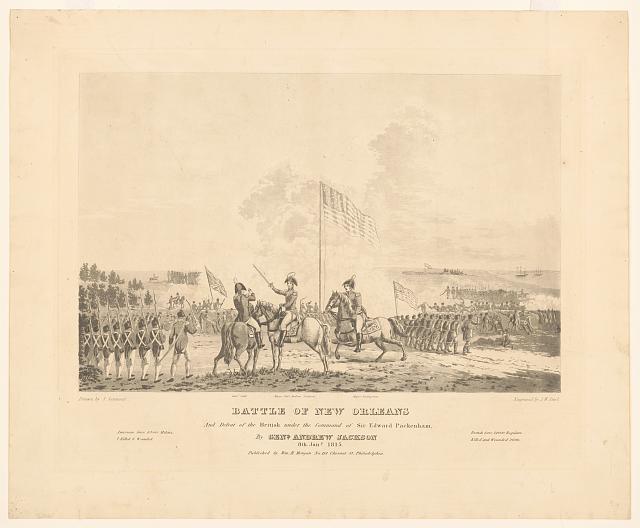
Major Livingston is depicted to the right of General Jackson under the flag.

The Battle of New Orleans was one of the few highlights in the otherwise embarrassing War of 1812. It also created the legend of Andrew Jackson and led to his presidency and the entire “Age of Jackson.” By his side throughout the New Orleans campaign was one man who helped Jackson in matters military, civil, legal and in almost every other way. His future Secretary of State, Edward Livingston.
         

\”Beau Ned\” as he was sometimes known

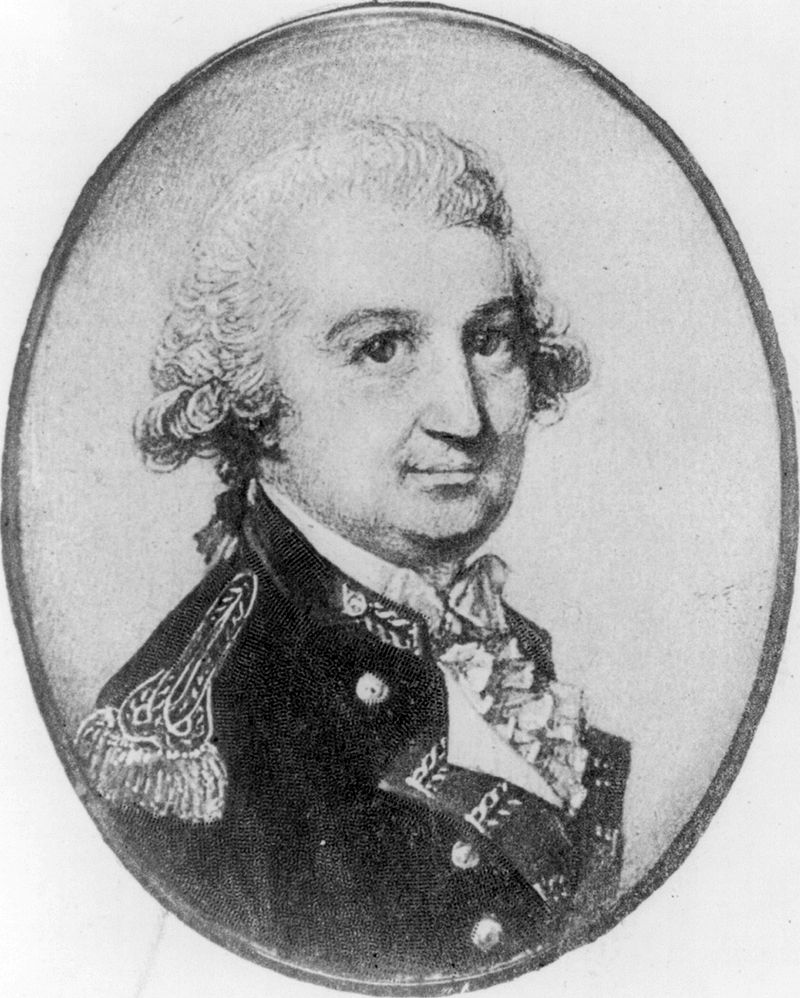
Edward was the youngest child of Judge Robert R. Livingston and Margaret Beekman Livingston. He had been born in 1764, making him too young to join his older brothers in the American Revolution although he had spent some time at George Washington’s headquarters at the very end of the war, as a gentleman volunteer.

Edward had arrived in New Orleans shortly after his brother Robert had negotiated the Louisiana Purchase from the French. He was looking for a fresh start after having resigned as Mayor of New York City and United States District Attorney amid a scandal created by an aid that was exasperated by Thomas Jefferson and Albert Gallatin. He quickly became a prominent lawyer in the city. In 1814 with fears of an attack by the British mounting, Edward was made chairman of a committee to defend the city. He was soon corresponding with Andrew Jackson,

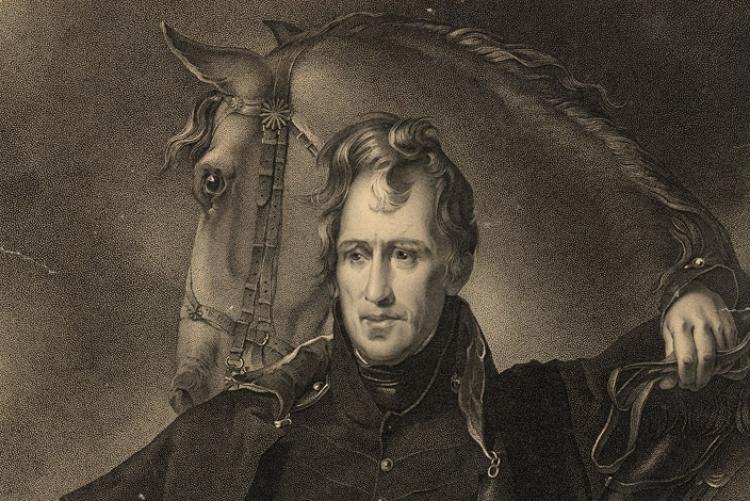
Jackson\’s hair deserves its own portrait

who had been ordered to defend the city but who was still in Mobile, Alabama.

On the surface, there is little to suggest that Edward and Jackson should become friends. They had probably met in the 1790’s when they both served in congress. The refined gentleman from the Hudson River Valley and the rough backwoodsman from Tennessee, but their differences seemed to compliment rather than clash. Perhaps too, they bonded over a mutual dislike of the British developed as boys during the American Revolution. Jackson had been captured while acting as an unofficial messenger and was slashed with a saber, leaving life-long scars on his hand and head. His mother and brothers had died of smallpox during the war. Edward had seen his home burned by the British and his brother-in-law, Richard Montgomery killed in battle.
When Jackson arrived in New Orleans with his 1,000 American regulars Edward was among those there to greet him, translating Jackson’s arrival speech into French. Soon Edward had been made aide-de-camp with the unofficial rank of major. Edward’s young son Lewis, only about 16 years old, was made a captain and assistant engineer.
One of Jackson’s first commands in New Orleans was to impose martial law on the city. He felt that many of the citizens might not offer their full support to the army without a little prodding. Edward warned him that the move might not be constitutional but supported Jackson. Later Jackson would be fined for this move and have a hard time shaking a reputation for tyrannical behavior.
Monopoly breaker
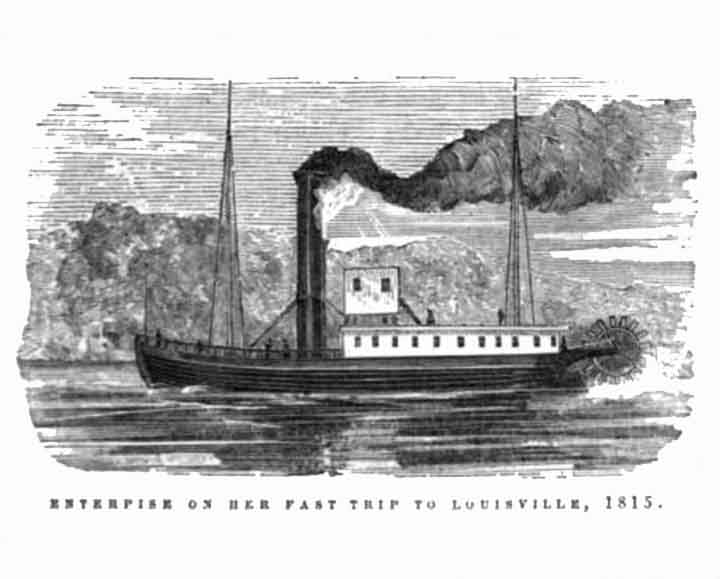
A steamship, Enterprise, arrived at New Orleans with military supplies. Under normal circumstances the ship would have been in violation of Edward’s brother’s monopoly on steam ships on the Mississippi but martial law as well as Robert’s death in 1813 made that impossible to enforce. Even with these supplies Jackson found himself desperately short of ammunition. Livingston stepped in at this point again and helped to facilitate a deal between Jackson and his acquaintance and possible legal client, Jean Lafitte.

The dread pirate Jean Lafitte

Lafitte was the leader of the Baratarian pirates. He brought as many as 1,000 men to fight alongside the Americans as well as a seemingly endless supply of shot and gunpowder that he had preciously stocked in various hiding places in the bayous around New Orleans for his own piratical purposes.
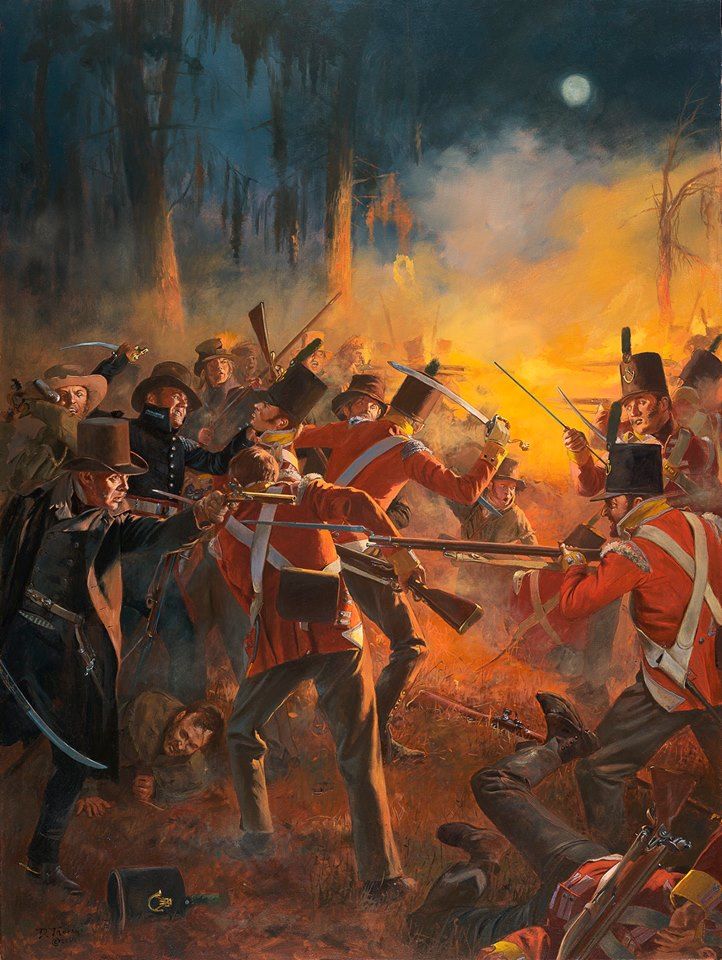
On December 23, 1814, the British began to land near New Orleans. It has been claimed that Jackson declared that the British would never sleep on American soil. He ordered a night attack. The fighting was intense, violent and bloody and devolved in to hand to hand fighting with bayonets, knives and hatchets. Edward was mounted on horseback during the battle relaying order from Jackson to other officers, under fire the whole time. Jackson mentioned his bravery in his report on the battle at Villere’s Plantation.
Night fighting
The Americans spent the next several days preparing a fortification along a canal where they would make their stand. Edward became convinced that he would die in battle, even going so far as to write a farewell letter to his older siste Janet Montgomery. On January 7, 1815, the American troops assembled in what would become known as Jackson Square in the French Quarter of New Orleans. Jackson and Livingston had written a speech to rally the men and surprisingly chose to let Edward deliver it. He appealed to the zeal of Americans whose fathers had defeated the British in the Revolution, to the French and Spanish who had a hereditary hatred of the British. He appealed to the militia, the uniformed men and to the battalions of black men who had been assembled for the defense of New Orleans.
The final British assault began on January 8, 1815. The weeks between their landing and this attack had been filled with artillery duels and small scale attacks. The British army moved on Jackson’s line. Jackson, with Livingston at his side was on the line. The 44th Regiment of Foot, the 95thRifles, men who had spent the last decade fighting Napoleon. They were stopped and mown down in front of the American Line. Sir Edward Pakenham, commander of the British army, was killed by rifle fire. Finally, the British retreated out of range of the American guns. Jackson was convinced not to follow them.

The battlefield was covered in the bodies of fallen British soldiers. Almost miraculously as Jackson and other officers stood on the parapet surveying the battlefield nearly 500 of the bodies stood up. Many soldiers had simply lay down to avoid being killed and now found themselves prisoners of war.
Edward was brevetted colonel and put in charge of the prisoners from the battlefield as well as those taken during the December 23 night attack. He headed down river to negotiate an exchange with the British only to find himself taken prisoner, despite much protesting, as the British attacked an American fort on Mobile Point to try to save face. He witnessed the surrender of the fort from a British ship.
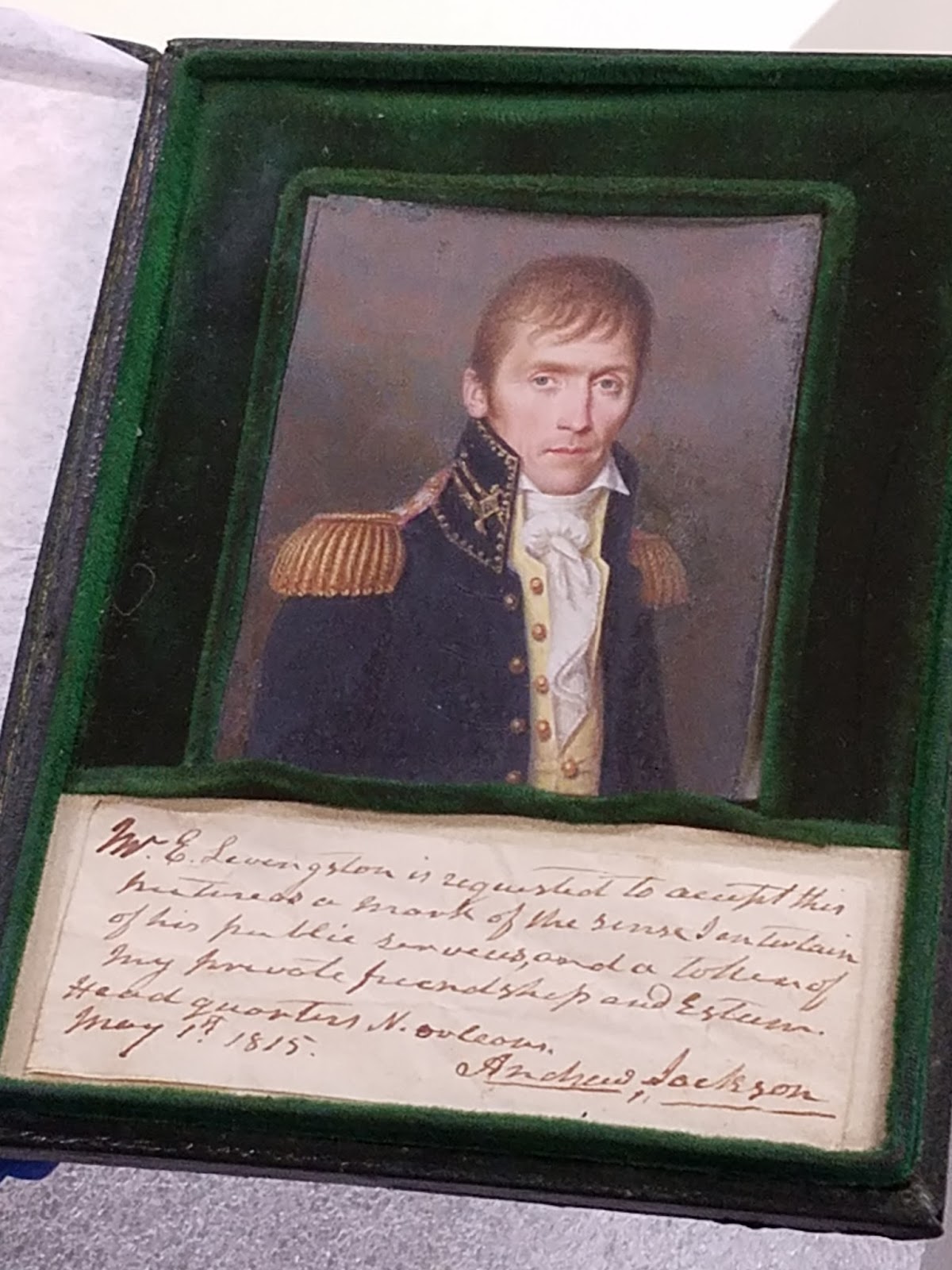
The next day, February 13, 1815, word arrived to the British that the Treaty of Ghent had been signed. Edward was released and returned to New Orleans. There Jackson presented him with a miniature of himself painted on ivory, along with a note of thanks for his services and friendship during the campaign. The miniature is now in the collection of Montgomery Place at Bard College.

Was the hair all a lie?  From the Collection of Montgomery Place at BardCollege            

When Jackson was elected president, he made Edward his Secretary of State and later his minister to France. Following these services Edward retired to Montgomery Place, which his sister Janet Livingston Montgomery left him in her will, to live out his remaining years in the same valley he grew up in finally at peace.